
Originally published in 2017, this article has been refreshed while preserving its original idea and the reader discussion below.
Can a long-running medical drama teach us something about blogging? Surprisingly, yes.
Grey's Anatomy has spent years returning to themes such as fear, fresh starts, uncertainty, technology, commitment and relationships. Those same themes show up constantly when you are building a blog or online business - just with considerably fewer operating rooms.

Fear of Failure Can Keep a Blog Stuck
One of the recurring ideas in Grey's Anatomy is what happens when people delay difficult decisions because they are afraid of making the wrong one.
Bloggers do this too. We postpone starting an email list because we do not understand the technology. We avoid updating an old article because it feels overwhelming. We wait to pitch a brand until our numbers are "better." We leave an imperfect About page untouched for three years because rewriting it means deciding how we actually want to present ourselves.
Sometimes caution is sensible. But there is a difference between making a thoughtful decision and remaining permanently stuck because we want certainty first.
You are going to make mistakes. Some posts will flop. A strategy you were certain would work may accomplish very little. A platform you invested in may change. None of that means the attempt was wasted if you learn enough to make the next decision better.
Fresh Starts Do Not Require January 1
Another theme the show returns to is the possibility of beginning again.
That matters in blogging because real life does not respect editorial calendars. Illness happens. Families need us. Businesses change. Motivation disappears. Sometimes we deliberately step away because something else deserves our attention more.
A break can affect traffic or momentum, but it does not erase everything you built.
You also do not need to wait for New Year's Day, a Monday, a new quarter or a perfectly redesigned website to restart. Choose the next useful action. Update one important article. Send the next email. Repair one broken page. Publish something worthwhile.
Starting again is still progress.
Your Blog's Future Probably Will Not Look Like Your Original Plan
When people begin something, they rarely know exactly where it will lead. Blogs are especially good at proving this.
A site may begin as a hobby and become a business. A niche may narrow or expand. The audience may reveal needs you never expected. A blogger who originally planned to make money from ads may discover that books, services, affiliates, courses or products are a much better fit.
Planning still matters. Set goals and decide what you are working toward. But revisit the plan instead of treating it as a contract with your past self.
Ask periodically: What is working? What has changed? What do readers need now? What produces income? What consumes time without producing enough value? What do I actually want this business to become?
A useful plan gives you direction while leaving room to learn.
New Technology Is Not Automatically Better
This lesson may be even more relevant now than when this article first appeared.
Bloggers are constantly offered new tools promising to streamline, automate, optimize or revolutionize our work. Some are genuinely useful. Others create another dashboard, another subscription and another system we have to maintain.
Before adding a tool, ask what problem it solves. Then ask whether you already have something that solves the same problem.
Technology should reduce friction or improve results. If a new system takes more time to manage than the problem it replaced, reconsider it.
This applies to social platforms too. You do not need to be everywhere simply because a new platform is getting attention. Your time is a business resource.
Commitment Does Not Mean Working Every Minute
The original version of this article compared the commitment required in medicine with the commitment required to build a professional blog. The comparison led to a useful point, but it deserves an important distinction.
Taking a blog seriously does not require giving it 100 percent of your life.
It does require following through on the work that matters. If you want the site to become a business, you need some consistency in publishing, promotion, email, products, monetization or whatever supports your particular model.
Consistency also does not mean forcing yourself to publish three times a week forever. A useful article once a week - or even less frequently - can be more valuable than publishing constantly just to meet an arbitrary schedule.
Choose a rhythm that you can sustain alongside the rest of your life.
Other Bloggers Do Not Have to Be Your Enemies
A medical drama needs rivalry because rivalry creates drama. A blogging business does not.
Someone else can write about gardening, food, books, blogging, travel or parenting without taking away your ability to do the same. Your experience, voice, audience, offers and approach create differences even when subjects overlap.
Other bloggers can become collaborators, referral partners, guest contributors, sources, friends and people who understand work that can otherwise feel very solitary.
That belief is central to the Biannual Blogathon Bash. We can improve our own sites while helping other people improve theirs. Collaboration and individual success are not opposites.
Sometimes the Right Move Is to Change Direction
One of the harder business lessons is recognizing that commitment and stubbornness are not the same thing.
If a strategy is not working, investigate why. If a topic no longer fits, decide whether it belongs in your future. If an income stream takes enormous effort for almost no return, test a different path. If a project once mattered but no longer does, finishing it may not actually be the best use of your time.
Changing direction does not automatically mean you failed. Sometimes it means you finally have enough information to make a better decision.

Which Blogging Lesson Do You Need Right Now?
If several of these lessons sound familiar, do not try to fix everything this weekend. Start with the problem creating the biggest bottleneck.
- You keep postponing something important → Fear. Choose the smallest version of the task and finish it.
- You have not published or emailed in a while → Fresh start. Restart with one useful piece of content instead of trying to catch up.
- You are working constantly but are not sure why → Future. Review what you actually want the blog to accomplish during the next 90 days.
- Your business feels complicated → Technology. Audit your tools, subscriptions and platforms and remove one source of unnecessary friction.
- You are exhausted by your publishing schedule → Commitment. Create a schedule you can realistically sustain.
- Blogging feels lonely or competitive → Community. Reconnect with one blogger, creator or professional peer.
- You are pouring time into something that is not working → Change. Decide whether to improve it, replace it or stop doing it.
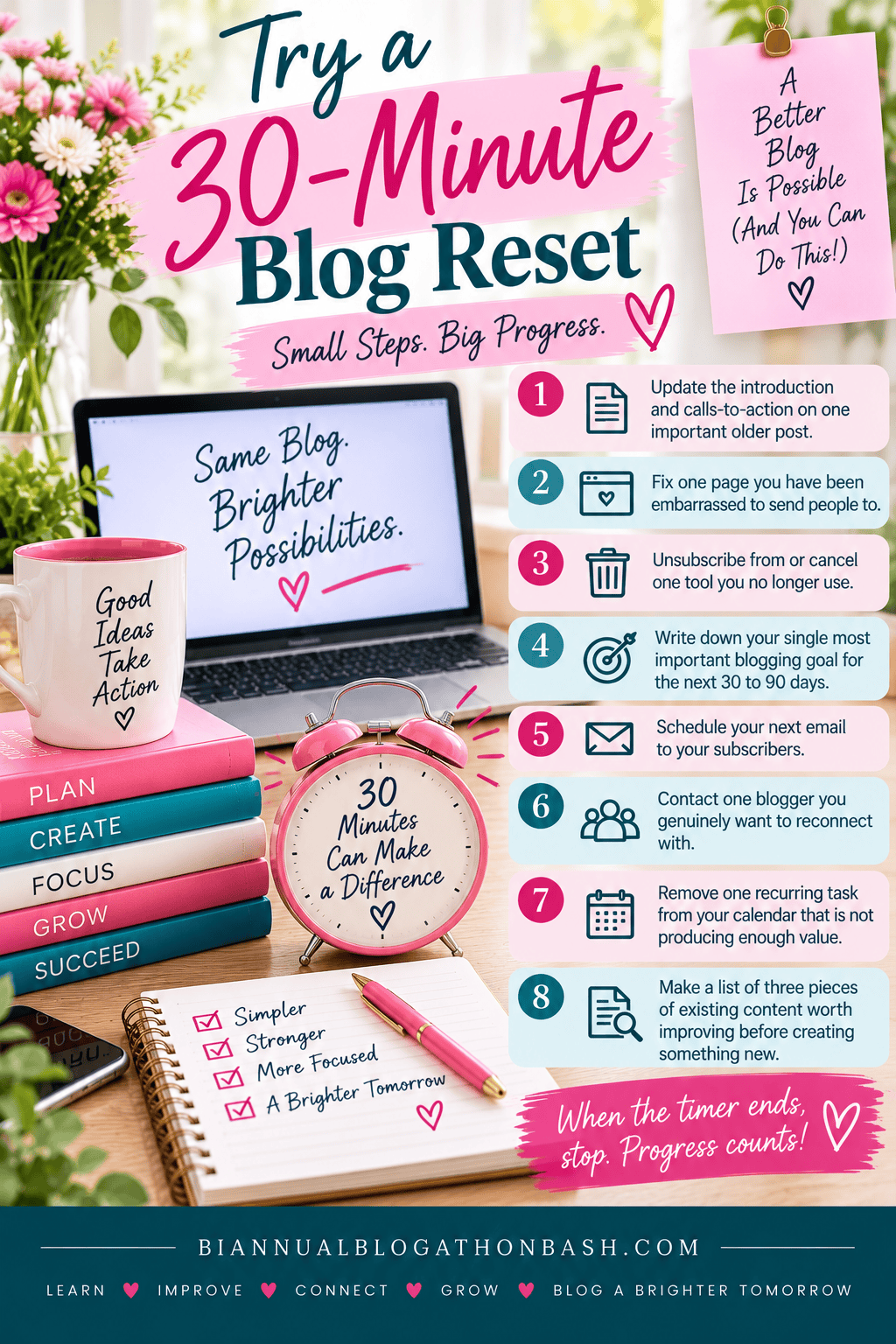
Try a 30-Minute Blog Reset
You do not need an entire weekend to start moving forward. Set a timer for 30 minutes and choose one:
- Update the introduction and calls-to-action on one important older post.
- Fix one page you have been embarrassed to send people to.
- Unsubscribe from or cancel one tool you no longer use.
- Write down your single most important blogging goal for the next 90 days.
- Schedule your next email to your subscribers.
- Contact one blogger you genuinely want to reconnect with.
- Remove one recurring task from your calendar that is not producing enough value.
- Make a list of three pieces of existing content worth improving before creating something new.
When the timer ends, stop. The goal is not to rebuild your entire business in half an hour. It is to prove to yourself that progress does not require a perfect plan or a perfectly clear calendar.

Frequently Asked Questions About Getting a Blog Back on Track
Do I need to start over if my blog has been neglected?
Usually, no. An established blog may already have useful content, search history, backlinks, subscribers and brand recognition. Start by identifying what is worth keeping, what needs updating and what no longer serves the direction you want to take.
How do I know whether to fix an old blogging strategy or abandon it?
Look at both results and opportunity cost. If something is producing meaningful traffic, revenue, subscribers or relationships, improving it may make sense. If it consumes significant time without supporting your current goals, changing direction may be the better business decision.
How often should I reevaluate my blogging goals?
A quarterly check-in works well for many bloggers. You do not need to completely rewrite your business plan every three months, but you should know whether your current work is still moving you toward something you actually want.
Do bloggers need to publish constantly to succeed?
No single publishing frequency works for every blog. Consistency matters more than an arbitrary quota. Updating valuable existing content, emailing subscribers, promoting proven posts and creating products can sometimes be more useful than continually adding new articles.
What should I work on first if my blog needs a lot of attention?
Start with the bottleneck closest to your primary goal. If you need traffic, examine the content already attracting visitors. If you need revenue, examine monetization and conversion paths. If you need subscribers, improve your email signup and lead magnet. If you feel overwhelmed, simplify before adding anything new.
A Blog Is Allowed to Evolve
Perhaps that is the biggest lesson a long-running television series can offer a long-running blog: things change.
People change. Technology changes. Audiences change. Businesses change. What made sense several years ago may not make sense now.
The goal is not to predict every change. It is to keep learning, preserve what still matters, let go of what does not and keep building something that supports the life you actually want.
That is much more sustainable than trying to follow a blogging plan that never changes.








Lois Christensen says
Ohhh...I like the fresh starts part! Never give up, keep on trying until you find the right niche for you and your blog.
Desiree Lopez says
I could agree with so many of the points you mentioned but the one that gets me the most is with procrastination. So many opportunities get lost with not being more proactive. This was a fun way to get your ideas across though. I enjoyed reading the post!
Kathleen Bailey says
Yes! Exactly.
Chevelle says
Two of my favorite things : Greys & blogging! Love!
connie says
Love your insights and analogies. Never put off ;til tomorrow what you can do today. Love it.
lilpickmeup says
While I don't watch Grey's Anatomy I do like the "less is more" approach. I agree with blogging it takes dedication.
Kathleen Bailey says
Thank you for your thoughts.
krystal says
I would love to use some of these tips especially about minimalism! I need more help with the procrastination!
kristi says
Who knew there was more to that show than meets the eye. What a fun way to learn and compare. Thanks for the great read this morning.
Kathleen Bailey says
My pleasure, I hoped it would be a fun read.